
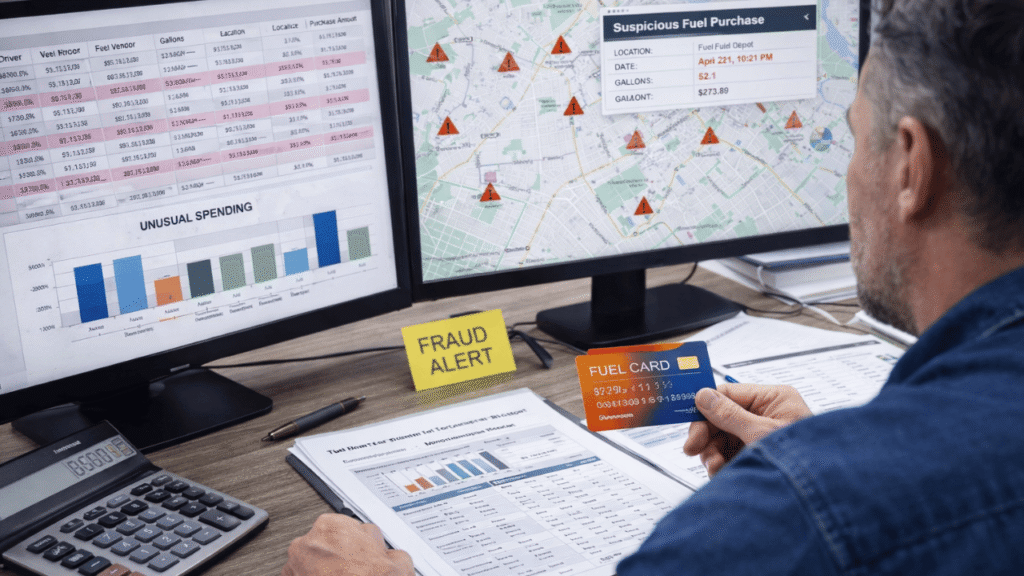
Fuel card fraud patterns rarely appear all at once. It hides in transactions that look normal, builds up slowly over weeks, and by the time most fleet managers notice something is wrong, thousands of dollars have already been lost. One of the best things a fleet operator can do is learn to spot patterns of fuel card fraud early.
This guide goes over what those patterns look like, how to find them in your transaction data, and what to do if something doesn’t add up.
Table of Contents
Why Fuel Card Fraud Patterns Are Easy to Miss
The main reason fuel fraud goes unnoticed for so long is that each transaction looks perfectly normal. A $200 fill-up at a truck stop by itself isn’t that strange. But three $200 fill-ups on the same card in 18 hours should definitely raise a red flag.
Fraud doesn’t usually happen in one big deal. It grows slowly, in small amounts, in familiar places, and at normal times of day. Someone who knows how fleet monitoring works will make sure to stay below the alert thresholds. That’s why it’s so important to find patterns in data. You don’t want to find just one bad deal. You want to see behavior that doesn’t fit the normal range over time.
How to Identify Fuel Card Fraud Patterns: The Warning Signs
Transactions That Exceed Tank Capacity
This is one of the most obvious signs of fraud and one of the easiest to check. The tank size of each vehicle in your fleet is set. If a transaction shows more gallons bought than the tank can hold, either someone filled up a second vehicle or container on the company card, or the transaction data was changed.
Set your fuel card controls to flag or block any purchase that exceeds the vehicle’s tank size. When those alerts go off, don’t just assume it was a system error; look into it right away.
Multiple Fill-Ups Within a Short Time Window
Under normal circumstances, it’s not common for a driver to fill up twice on the same route in a few hours. Two hours later, a truck that was just filled doesn’t need another full tank. You should look closely at any fuel card fraud patterns that show up when you see two transactions on the same card in a short amount of time.
Get the GPS data for that car and compare it with the transaction times and locations. If the car’s location doesn’t match where the card was used, someone else is likely using the card without permission or sharing it.
Purchases Outside Approved Routes or Locations
Every fleet has a set geography. Your drivers always drive in the same lanes, stop at the same stations, and work in the same areas. A fuel purchase that shows up 300 miles outside a driver’s normal route is a big deal, especially if it occurs while the vehicle’s GPS shows it parked in a yard.
This pattern usually means that people are sharing cards. A driver gives their card or PIN to someone else, who then uses it. The car never moves, yet new transactions keep appearing. Fleet fraud detection tools that compare a transaction’s location with its GPS position automatically catch this.
Transactions During Off-Hours
If your fleet runs Monday through Friday during business hours, you should explain why you bought fuel on Saturday night. Transactions that occur outside normal business hours are among the most reliable signs of misuse because they don’t occur very often.
Set time limits on your cards to prevent this from happening entirely, and set up fraud alerts to notify you right away when a transaction occurs outside approved hours. Don’t assume that a purchase made at night was an authorized extended shift without checking it out yourself.
Gradual Spending Escalation
Fraud that starts small and grows slowly is deliberately made hard to find. At first, a driver might add a few extra gallons here and there, but once they are sure no one is watching closely, they will start to add more.
This pattern is easy to see in regular fuel transactions. If a certain card or driver spends more on gas every week without driving more miles or taking more complicated routes, that increase is worth looking into. Look at how much each driver spends on gas per mile driven on similar routes. When you look at the data side by side, outliers are easy to spot.
Suspicious Fuel Purchases at Non-Fuel Merchants
Only authorized gas stations should accept fuel cards. If your card program lets more merchants use it, and you’re seeing transactions at convenience stores, auto shops, or other places that don’t sell gas, those purchases are almost certainly not allowed.
Even small purchases that don’t involve fuel are important. To see if a card works outside of its limits, a person will often make a small purchase first before trying something bigger. Limit your cards to merchants that only sell gas, and treat any exceptions as possible red flags that need to be looked into right away.
Round-Number Transactions
Most of the time, real fill-ups don’t end in a perfectly round number. If you always buy gas for exactly $50, $100, or $150, it means you entered the information by hand instead of using a pump. This is a common sign of fake or fraudulent charges.
Look for this pattern in your transaction data in particular. It could be a coincidence that you bought a round number. A driver who has made multiple round-number transactions on different days is spending money in an out-of-the-ordinary way. This calls for a direct conversation and a more in-depth audit.
Duplicate Transactions
Two identical charges on the same card, with the same amount, location, and date, are a clear sign of a problem with the transaction. This could happen due to system errors, but it could also mean that two people are using the same compromised card at the same time, or that someone is intentionally double-billing.
Every month, check your fleet’s transaction history for duplicate transactions. This is a built-in report on most fuel card platforms. If you see duplicates, don’t wait for the review to finish; instead, freeze the card while you investigate.
Building a System for Ongoing Fraud Monitoring
It’s important to spot individual red flags, but the best way to protect yourself is to make regular security monitoring part of your daily routine. A few simple habits can make a big difference:
- Check transaction reports weekly, not monthly. The sooner you find an anomaly, the less it will cost you. Monthly reviews give fraud weeks to build up before anyone notices.
- Check fuel data against GPS mileage regularly. There is a gap that needs to be explained for a car that drove 800 miles but bought gas for 1,200 miles.
- Set up automatic fraud alerts for key thresholds, such as tank capacity limits, off-hours activity, location boundaries, and spending caps. Let the system flag unusual events so you can spend your time reviewing real problems rather than sifting through clean data.
- Audit high-spend cards periodically even if everything seems fine. Proactive audits find patterns that are building slowly but haven’t yet triggered automated alerts.
- Before jumping to conclusions, talk to your drivers when something seems off. There are times when there is a good reason. But talking right away, instead of weeks later, makes it clear that people are keeping a close eye on the transactions.
Stay Ahead of Fuel Card Fraud Patterns
Fuel card fraud patterns don’t just go away. They get bigger until someone goes out of their way to find them. The fleets that lose the least to fraud don’t always have the most advanced technology. Instead, they regularly check their data, set meaningful controls, and act quickly when something doesn’t make sense.
To begin, figure out what a normal amount of fuel spending looks like for each driver, vehicle, and route. Anything different from that baseline should be looked at again. Make this a weekly habit, and you’ll see fuel card fraud patterns long before they become a big financial problem.
Reach out today at getfuelcard.com, call +1 905-901-160, or email at hello@getfuelcard.com to find a fuel card program that has the monitoring tools, fraud alerts, and transaction controls your fleet needs.