
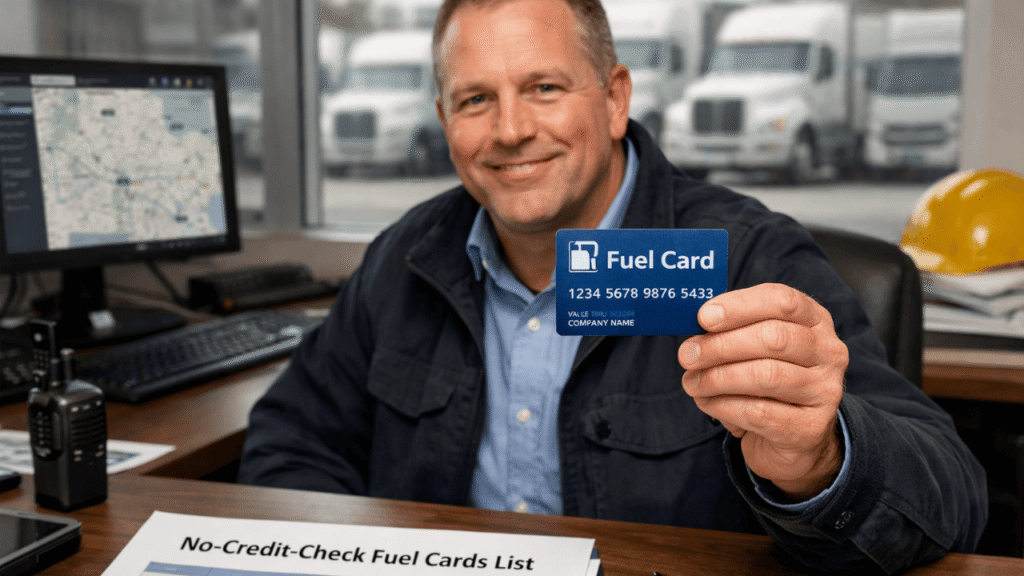
Running a trucking business is already hard enough. The last thing you need is a fuel card rejection slowing you down before you even hit the road.
If your credit score isn’t where you want it to be, or you’re brand new to the industry, traditional fuel cards can feel like a closed door. But no-credit-check fuel cards exist specifically for situations like yours. They give you access to real fuel discounts, spending controls, and expense tracking without the credit hurdles of conventional options.
This guide breaks down everything you need to know: how these cards work, the different types available, and how to pick the right one for your operation.
Table of Contents
No-Credit-Check Fuel Cards Explained
Most standard fuel cards work like a credit card. You use the card, receive a monthly statement, and pay the balance. Because the card issuer takes on financial risk, they run a credit check before approving you.
No-credit-check fuel cards take a different approach. Instead of evaluating your creditworthiness upfront, these cards either require you to preload funds, accept a deposit as collateral, or assess your business based on factors other than your credit score. The result? Easier approvals, faster setup, and access to the same fuel savings you’d get from any other fleet card.
What Makes These Fuel Cards Different?
The biggest difference is in how the risk is managed. With a traditional fuel card, the issuer extends credit and hopes you repay it. With no-credit-check options, the risk is either eliminated (prepaid) or offset (secured deposit). That’s why approval is accessible to new trucking companies, owner-operators with bad credit, and businesses with little to no credit history.
Beyond approval, most of these cards still deliver solid benefits: per-gallon discounts, real-time transaction tracking, driver spending controls, and nationwide network coverage.
Understanding the Fuel Card Application Process
The application process for no-credit-check fuel cards is usually straightforward. Most providers ask for basic business information, your company name, contact details, DOT or MC number, and a valid ID. You won’t be asked to authorize a hard credit pull. Some cards, like prepaid options, can be activated the same day you apply. Others may take 24 to 48 hours for approval, with physical cards arriving within 7 to 10 business days.
Why Use Fuel Cards with No-Credit-Check?
Fuel is one of the highest operating costs in trucking. The average trucker spends somewhere between $50,000 and $70,000 on fuel every year. Every cent per gallon you save adds up fast across long hauls and multiple trucks.
Here’s why a no-credit-check fuel card makes sense for a lot of operators:
- You don’t have the credit history to qualify for traditional cards: New trucking companies and first-time owner-operators often have little to no business credit, which automatically disqualifies them from conventional fuel card programs.
- Your credit took a hit: Past financial struggles show up on credit reports, even when your operation is now profitable and running smoothly. No-credit-check fuel cards focus on your current situation, not your history.
- You want faster approval: Some trucking fuel payment options require weeks of underwriting. With these cards, you can get approved and on the road in days, or even hours with prepaid options.
- You want spending control without credit risk: Prepaid fuel cards let you cap spending at exactly what you’ve loaded onto the card. There’s no risk of running up a balance you can’t pay.
How No-Credit-Check Fuel Cards Work for
The mechanics depend on which type of card you choose, but the core idea is the same across all of them, you’re either spending your own money or backed by a deposit, so there’s no need for a credit check.
Prepaid Fuel Cards
You load money onto the card before your drivers hit the road. When a driver refuels, the amount is deducted from the balance. You can reload online or via a mobile app, and most offer discounts of 4 to 50 cents per gallon. The trade-off is that your spending is capped at whatever you’ve loaded, but that also means you can never spend more than you have.
Business Debit Fuel Cards
These work a lot like prepaid cards, except they pull directly from your business checking account in real time instead of a preloaded balance. You link your bank account, and every purchase is debited automatically. They’re a solid fit for operators who keep a healthy bank balance and don’t want to worry about manually reloading funds. Like prepaid cards, no credit check is involved, your available bank balance is the only limit.
Secured Fuel Cards
You put down an upfront deposit, typically between $500 and $5,000, and that becomes your spending limit. The card issuer holds the deposit as collateral, eliminating their risk and making approval straightforward regardless of your credit score. You still earn fuel discounts, and since some providers report payment activity to business credit bureaus, every on-time payment works toward building your business credit. A secured card is a smart bridge option if you’re working toward qualifying for a traditional fuel card down the road.
In all three cases, most providers pair the card with a mobile app or online portal where you can track every transaction, set driver spending limits, and monitor fuel costs across your entire fleet in real time.
Benefits of No-Credit-Check Fuel Cards for Truckers
Let’s get specific about what you actually gain by using one of these cards.
- Real fuel savings, no credit required: OTR’s fuel card cuts fuel costs by an average of $0.50 per gallon, with $0 in-network fees. At high-volume usage, that kind of savings can put hundreds of dollars back in your pocket every month without needing to qualify for credit.
- Fast approval that gets you moving: Approval typically takes just 24 to 48 hours, with cards arriving within 7 to 10 business days. Prepaid fuel cards can activate immediately once funded. When you need to get on the road fast, that timeline matters.
- Nationwide network coverage: Most major no-credit-check providers offer broad acceptance. OTR is accepted at more than 8,000 stations nationwide, with exclusive discounts at 3,000-plus in-network locations, and $0 in-network transaction fees. You won’t have to go out of your way to find a participating station.
- Spending controls for every driver: Fleet fuel financing solutions like these cards let you set per-driver limits, restrict purchases to fuel only, and get alerts on suspicious transactions. This is especially useful when you’re managing multiple trucks or drivers.
- Real-time expense tracking: Every swipe is logged. You can view transactions from a dashboard or mobile app, simplify IFTA reporting, and monitor how much each truck is spending without chasing down paper receipts.
- Credit-building potential: Some no-credit-check fuel cards report your payment history to Dun & Bradstreet, Experian, and Equifax. AtoB fuel cards, for example, report to all three major business credit bureaus, which means every on-time payment can help build your business credit score over time. That opens doors to better financing options later.
- No personal guarantee required: Several major providers no longer require personal guarantee requirements. That’s meaningful protection for owner-operators who don’t want to put their personal finances on the line.
Ways to Get Approved for No-Credit-Check Fuel Cards
Getting approved is easier than you think. Here’s a step-by-step look at the process.
1. Pick the card type
Start by matching the card type to your situation. If you want the simplest approval, go prepaid. If you want to build credit while you fuel, consider a secured option.
2. Gather all necessary documents
Most providers ask for your business name, contact information, DOT or MC number, a valid government-issued ID, and basic banking information. Have these ready before you start the application.
3. Apply with a specialized provider
Look for providers that specifically cater to truckers with no credit history or bad credit. Some companies focus on the trucking industry and have built their programs around the realities of fleet operations.
4. Provide a deposit or preloaded funds if required
For prepaid cards, you’ll fund them before you can use them. For secured cards, you’ll submit a deposit. Either way, make sure the amount you set aside makes sense for your expected fuel volume.
5. Set usage and payment preferences
Once approved, configure your spending limits, driver restrictions, and alerts. The more guardrails you set up, the easier it is to manage fuel costs across your operation.
6. Wait for approval and activate the card
Most approvals come within 24 to 48 hours. Physical cards typically arrive within 7 to 10 business days. Prepaid digital cards can be activated right away.
7. Build a Positive Usage History
Use the card consistently and keep your balance funded, or make payments on time. Paying your balance on time every month and using your card strategically helps rebuild credit, and if your card reports to credit bureaus, those on-time payments start working in your favor immediately.
When a Low Credit Score Blocks Your Fuel Card Approval
Credit score requirements are among the most common reasons truckers are turned down for traditional fuel cards.
Most providers want a Paydex score of at least 50 (low-to-moderate risk) or a personal FICO score of 580 or higher. New owner-operators often can’t meet that bar, not because of bad decisions, but simply because they have no credit history yet.
On top of that, every rejected application triggers a hard inquiry that can drop your score by 5 to 10 points. Apply to the wrong cards repeatedly, and you’re making your credit situation worse while still getting nowhere.
The smarter move is to start with a no-credit-check option, use it consistently, and let your payment history build the credit you need to qualify for better cards later.
Choosing the Right Fuel Card Program
With several fleet fuel financing solutions on the market, here’s how to narrow down your choice.
- Think about your cash flow situation: If cash flow is tight, a prepaid card with instant activation might be the better fit over a secured card that ties up $500 to $5,000 in a deposit.
- Check the network coverage: Make sure the card is accepted at your usual locations. A card accepted at 8,000 stations nationwide covers most operators well, but if you run specialized regional routes, verify coverage in those specific areas.
- Look at the real per-gallon savings: Don’t just look at the headline discount. Compare savings at the stations you actually use. Some cards offer bigger discounts at specific truck stop chains, so the best card for you depends on where you fuel.
- Watch for hidden fees: Some traditional fuel card providers charge transaction fees of $2.50 per purchase, monthly maintenance fees of $8 to $60, and out-of-network fees that eat into your fuel savings. Look for fuel card providers with transparent pricing and no hidden costs.
- Consider credit-building potential: If building your business credit is a priority, look for a card that reports to Dun & Bradstreet, Experian, or Equifax. Not every no-credit-check card does this. It’s worth confirming before you apply.
- Match the card to your fleet size: Some cards work better for solo owner-operators, while others scale well for multi-truck fleets with driver-level controls and weekly reporting. Pick the one that fits where you are now, not just where you hope to be.
No-credit-check fuel cards aren’t a compromise. For many truckers, they’re actually the smarter starting point, lower risk, faster access, and a built-in path toward stronger credit and better financing options down the road.
Need Help Finding the Right No-Credit-Check Fuel Card?
Visit getfuelcard.com, call +1 (905) 901-1601, or email hello@getfuelcard.com to explore fuel card options designed for owner-operators and fleets. Our team can help you find fuel card solutions that simplify payments, improve fuel tracking, and support your trucking business as it grows.